
Fire Joker RTP, Math Engine & Beginner Strategy
Slot mathematics can look intimidating, but understanding the Fire Joker algorithm is the easiest way to protect your budget. The game operates on a certified RNG, meaning every spin result is independent of the last. By learning how the theoretical return, variance constraints, and expected value work together, beginners can set smarter limits and avoid draining their balance prematurely.
Before you calculate your session budget, you need to know how to check which mathematical configuration your chosen operator is running.
Variable RTP Banding: How to Check Your Fire Joker RTP
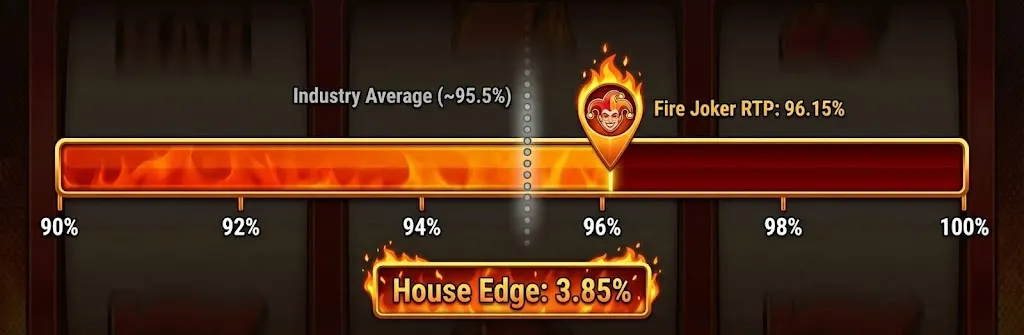
Play'n GO distributes Fire Joker with multiple certified RTP configurations. The game is available in several bands depending on the operator's chosen setting, and the active configuration directly affects how quickly your balance depletes. If the operator displays RTP in the in-game info or help panel, check it before spinning to confirm you are playing the highest available return band.
| RTP Band | House Edge | Note |
|---|---|---|
| 96.15% | 3.85% | This is the band to look for. |
| 94.23% | 5.77% | Secondary certified configuration. |
| 91.23% | 8.77% | Tertiary tier. |
| 87.24% | 12.76% | Lowest commonly listed configuration. |
Some operators may run additional certified configurations not listed here; always verify the active band in the game's info panel where available.
Why the Active Band Matters
The difference between the 96.15% and 87.24% bands is not a rounding error — it is a completely different game economy. On the lowest commonly listed setting, the house edge climbs to 12.76%, meaning you lose more than three times faster per spin than on the premium band. If the operator displays RTP in the info panel, checking it takes five seconds and can save your entire session budget.
Identifying the active RTP configuration is step one; step two involves translating that percentage into your actual expected cost per session.
House Edge Explained: What Happens to a C$10 Deposit?
The expected value calculation converts the theoretical return into a projected monetary cost. The formula multiplies your total session wager by the active house edge percentage. Think of the result as the price of entertainment — the mathematical rent the algorithm charges for every spin cycle.
Scaling the Example
At C$0.10 per spin and 100 spins, your total wagered amount is C$10.00. The 3.85% edge costs you roughly C$0.38 in expected value. Raise the stake to C$1.00 per spin over the same 100 spins and the total wager jumps to C$100 — now the expected cost is C$3.85. The house edge percentage stays fixed; only your total wagered amount scales.
Expected value assumes an infinite timeline, but your actual gameplay operates within the short-term swings known as variance.
Medium Volatility: How Often Will You Win?
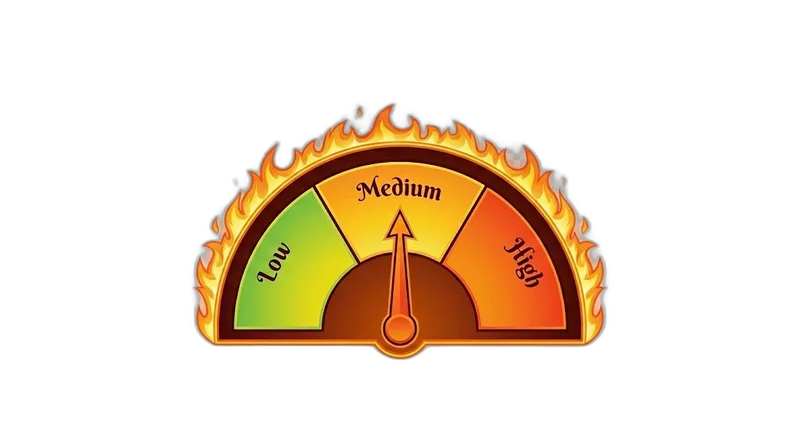
Variance determines how payouts distribute across your session. Fire Joker operates within medium volatility constraints, which creates a balanced rhythm suited for beginners. You will not wait hundreds of spins for a return, but you should expect steady smaller hits mixed with short losing streaks.
Reading the Rhythm
In practice, a 150-spin session at medium variance feels like this: short clusters of small wins, then a dry patch of consecutive losses, then another cluster. The Respin of Fire triggers inside those dry patches, converting some dead spins into partial recoveries. Understanding this rhythm prevents panic-betting during normal losing sequences.
This consistent payout rhythm keeps your balance active while the algorithm works toward the rarest event in the game — the maximum win.
The 800× Maximum Win: A Step-by-Step Breakdown
Fire Joker lacks dedicated free spins, so the highest payout relies entirely on a specific symbol alignment plus a multiplier roll. The 800× event is a statistical rarity, but the math behind it is straightforward.
- The RNG must align a full screen of nine Fire Joker Wild symbols on the 3×3 grid.
- Three Wilds on a single payline pay 80× the line bet. A full screen lands that combination on all 5 active paylines simultaneously.
- The total line payout is 5 × 80× line bet = 400× line bet. Because the total stake equals 5× the line bet, this converts to 80× your total stake.
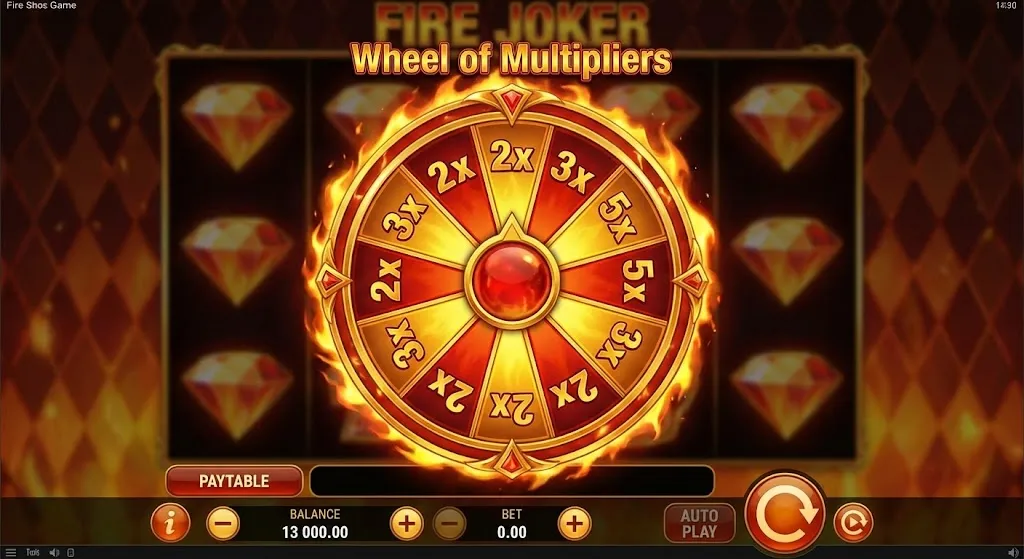
- The full-screen wild outcome automatically activates the Wheel of Multipliers bonus sequence.
- Landing the 10× sector on the Wheel scales the 80× base to reach the 800× absolute mathematical ceiling. At a C$100 stake, that equals C$80,000 — tax-free under CRA rules.
Why 800× and Not Higher
The cap is a direct product of the paytable math: the Wild is the highest-paying symbol at 80× line bet, and the Wheel's maximum sector is 10×. No other symbol combination or multiplier path exceeds this ceiling. Modern competitors routinely offer 5,000×–10,000× caps, which means Fire Joker trades jackpot depth for more consistent session pacing.
Since this maximum sequence cannot be forced or predicted, smart players focus on strict budgeting rules to extend their entertainment time.
Beginner Bankroll Strategy: The 150-Spin Rule
No betting system can overcome the mathematical house edge. The certified RNG evaluates every spin independently — previous results carry zero predictive weight. Effective bankroll management focuses entirely on extending your session length to absorb the losing streaks that medium volatility naturally produces.
- Divide your total session budget by 150 to set a baseline stake that absorbs medium variance dead-spin clusters. A C$15 budget means C$0.10 per spin; a C$30 budget means C$0.20 per spin.
- If the operator displays RTP in the game's info panel, check the active configuration before your first spin. Prefer the 96.15% band and avoid lower settings where possible.
- Never chase losses with progressive betting systems such as doubling your stake after a loss. The RNG evaluates every spin independently, so the game has no memory of your previous results.
- Avoid scaling your bet size to recover a deficit. This depletes the bankroll before the medium variance distribution can cycle into a winning swing.

Putting It Together
Set a hard stop-loss before you start: if your balance drops to 30% of the starting deposit, close the session. Set a win target too — walking away at +25% locks in profit that variance would otherwise reclaim. The 150-spin rule and the stop-loss work together: the rule sizes your stake, and the stop-loss limits your downside when variance runs cold.
Ready to apply this math at a real table? The main Fire Joker page lists every AGCO-registered operator in Ontario running this game. Or test these numbers risk-free in the demo first. AGCO-registered operators provide deposit limits, loss limits, and session time limits to help you stay in control.